
A health insurance policy can cover hospitalisation, surgery, diagnostic tests and other eligible medical expenses, but certain policy conditions may affect how much the insurer pays. One important condition that many policyholders overlook is the room rent limit.
When someone is admitted to a hospital, they may be offered several room categories, ranging from shared accommodation to a private room or suite. The cost can vary considerably depending on the hospital, location and type of room selected. If the chosen room exceeds the limit specified in the insurance policy, the policyholder may have to pay more than just the difference in room charges.
In some policies, exceeding the room rent limit can also result in a proportionate deduction on certain associated medical expenses. This can increase the amount payable by the patient, even when the treatment itself is covered. The impact can be significant when combined with other cost-sharing provisions, such as those explained in this guide on co-payment vs deductible in health insurance.
Understanding room rent limits, how they work and how they affect hospital bills can help you choose a suitable health insurance policy and avoid unexpected expenses during a medical emergency.
What Is a Room Rent Limit in Health Insurance?
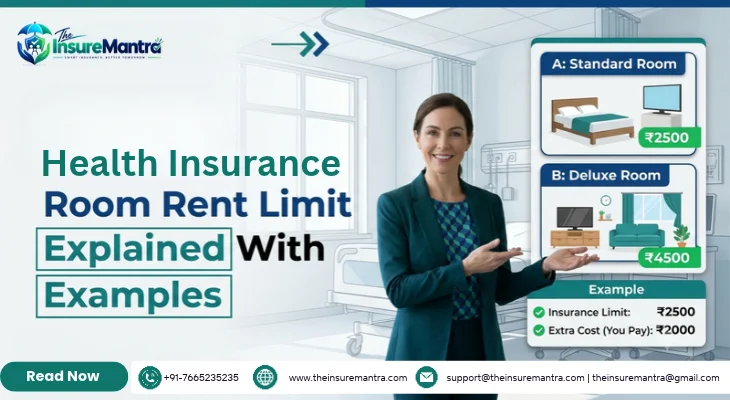
A room rent limit is the maximum daily room charge an insurer will recognise under the terms of a health insurance policy. It may be expressed as a fixed amount, a percentage of the sum insured, or an eligible room category.
For example, if your policy allows room rent of ₹5,000 per day and you choose a room costing ₹8,000 per day, the insurer may restrict the eligible room expense to ₹5,000 per day. Depending on the policy's wording, choosing the more expensive room could also affect certain associated medical expenses.
Room rent limits are not the same for every policy. Some plans have no monetary room rent cap, while others allow only specified room categories, such as a single private room or a shared room.
What Are the Different Types of Room Rent Limits?
Health insurance policies commonly use the following room eligibility structures.
1. Fixed Daily Room Rent Limit
The policy specifies a maximum amount that can be claimed per day.
Example: Your policy permits room rent up to ₹4,000 per day. If you stay in a room costing ₹6,000 per day, the difference may be payable by you, and other deductions may apply if the policy contains a relevant proportionate-deduction clause.
2. Percentage of the Sum Insured
Some policies calculate the daily room rent limit as a percentage of the total sum insured.
For example, if your policy has a 1% daily room rent limit, the calculation could look like this:
| Sum insured | 1% daily room rent limit |
|---|---|
| ₹3 lakh | ₹3,000 |
| ₹5 lakh | ₹5,000 |
| ₹10 lakh | ₹10,000 |
| ₹15 lakh | ₹15,000 |
These figures are illustrative. The actual amount payable may be subject to additional caps or other conditions specified in the policy.
3. Room Category-Based Limit
Instead of specifying a rupee amount, an insurer may define the room category you can choose.
For example, your policy may permit a single private room but exclude suites or certain premium room categories. In this situation, you should check the hospital's room classification rather than relying only on the daily price.
A room described as a "deluxe room" by a hospital may not necessarily match the category recognised by your insurer.
4. No Room Rent Limit
Some health insurance plans do not impose a specific daily room rent cap. Depending on the policy, this can provide greater flexibility when selecting a room.
However, no room rent limit does not mean unlimited coverage for every hospital expense. The sum insured, exclusions, co-payments, deductibles, treatment-specific sub-limits and other policy conditions can still affect the claim.
How Does a Room Rent Limit Work? Examples Explained
The practical impact of a room rent limit becomes clearer when you compare different hospitalisation situations.
Example 1: The Room Rent Is Within the Policy Limit
Suppose a policyholder has a ₹5 lakh health insurance policy with a daily room rent limit of ₹5,000.
The patient is admitted to a hospital for four days and chooses a room costing ₹4,000 per day.
| Particulars | Amount |
|---|---|
| Daily room rent limit | ₹5,000 |
| Actual daily room rent | ₹4,000 |
| Hospital stay | 4 days |
| Total room rent | ₹16,000 |
Because the selected room costs less than the policy limit, the room rent cap itself should not create a deduction. Other expenses will still be assessed according to the policy's terms.
Example 2: The Room Rent Exceeds the Policy Limit
Now consider a policyholder with the same ₹5 lakh sum insured and ₹5,000 daily room rent limit.
The patient chooses a private room costing ₹8,000 per day for five days.
| Particulars | Amount |
|---|---|
| Eligible daily room rent | ₹5,000 |
| Actual daily room rent | ₹8,000 |
| Difference per day | ₹3,000 |
| Total room rent for five days | ₹40,000 |
| Room rent recognised at the stated limit | ₹25,000 |
| Difference in room charges | ₹15,000 |
The immediate difference in room charges is ₹15,000. But the final amount the patient must pay could be higher if the policy also applies proportionate deductions to eligible associated expenses.
Example 3: How Proportionate Deduction Can Increase Out-of-Pocket Expenses
Proportionate deduction is an important concept to understand before selecting a hospital room. It refers to reducing certain associated medical expenses in proportion to the eligible room rent and the actual room rent, where the policy and applicable rules permit that calculation.
Suppose the policy allows ₹5,000 per day, but the patient chooses a room costing ₹10,000 per day.
The illustrative ratio is:
₹5,000 ÷ ₹10,000 × 100 = 50%
Assume, purely for illustration, that ₹80,000 of associated expenses are subject to a valid proportionate-deduction clause.
| Particulars | Amount |
|---|---|
| Associated expenses subject to the clause | ₹80,000 |
| Illustrative payable share at 50% | ₹40,000 |
| Illustrative deduction | ₹40,000 |
| Separate room rent difference for one day | ₹5,000 |
In this simplified example, the room rent difference and the deduction on associated expenses are separate amounts.
The calculation does not mean that every insurer can automatically reduce every hospital charge by 50%. The policy wording, applicable regulatory requirements, room-linked billing arrangements and treatment of individual expenses determine whether and how a deduction may apply.
Which Hospital Expenses May Be Affected by Room Rent Limits?
When a policy contains a proportionate-deduction clause, certain expenses linked to the room category may be affected. The exact treatment depends on the policy wording and applicable rules.
| Hospital expense | What to check |
|---|---|
| Room and boarding charges | Daily cap, eligible category and number of days |
| Doctor and specialist fees | Whether the charges are linked to room category |
| Surgeon and anaesthetist fees | Policy provisions on associated medical expenses |
| Nursing charges | Whether the insurer considers them room-linked |
| Operation theatre charges | Applicable policy wording and billing structure |
| ICU expenses | Separate ICU limit and applicable exceptions |
| Medicines and consumables | Whether they are independently admissible and protected from proportionate deduction under applicable terms |
| Diagnostic tests and implants | Specific exclusions, billing rules and applicable protections |
Do not assume that every item in this table will be reduced proportionately. Some charges may be treated differently, and the final settlement must follow the actual policy terms and applicable requirements.
Room Rent Limit vs ICU Room Rent Limit
A room rent limit applies to ordinary hospital accommodation, whereas an ICU limit concerns eligible charges for intensive care. Some policies have a separate ICU limit, which may be higher than the ordinary room rent limit.
For example, a policy might allow ₹5,000 per day for a regular room and specify a separate ICU allowance. These figures are illustrative; the policy may use another amount, percentage or method.
Before purchasing health insurance, check:
- The eligible room category for ordinary hospitalisation.
- Whether a separate ICU limit applies.
- Whether the ICU limit is a fixed amount or a percentage of the sum insured.
- The conditions that apply when an ICU admission transitions to a regular room.
- Whether the policy contains additional sub-limits or cost-sharing provisions.
An emergency admission should be managed according to medical needs. If the room category differs from the policy entitlement because of medical necessity or hospital availability, inform the insurer as soon as reasonably possible and retain supporting documentation.
Does a Room Rent Limit Apply to Cashless Claims?
Yes, a cashless claim may still be subject to room rent limits and other policy conditions. Cashless treatment means the insurer or its claims administrator coordinates eligible payment with the network hospital; it does not automatically remove policy restrictions.
For planned hospitalisation, ask the hospital's insurance desk to confirm the permitted room category and send the proposed room tariff and treatment estimate for pre-authorisation.
Review the insurer's response before choosing a room whenever possible. Pre-authorisation can help clarify the expected coverage, but it is not necessarily a guarantee of the final claim amount. The final settlement may depend on actual treatment, the final bill, supporting documents and policy terms.
How to Check Your Health Insurance Room Rent Limit
You do not need to wait until hospital admission to find out your room entitlement. Review your insurance documents in advance.
1. Read the Policy Schedule
Look for the room rent limit, permitted room category, ICU limit and any applicable sub-limits. If the policy uses a percentage of the sum insured, calculate the amount and check for any maximum cap.
2. Review the Customer Information Sheet
The Customer Information Sheet (CIS) summarises important policy features, including relevant financial limits and restrictions. Read it alongside the full policy wording rather than treating the summary as a substitute for the contract.
3. Check the Full Policy Wording
Search for terms such as "room rent," "room category," "sub-limit," "associated medical expenses" and "proportionate deduction."
These provisions explain the circumstances in which a limit applies and how the insurer calculates eligible expenses.
4. Confirm the Hospital's Room Classification
Ask the hospital which room category you would occupy and its daily tariff. Confirm that the category matches the terminology used in your policy.
5. Request Written Clarification
If you are uncertain about a room upgrade, contact the insurer or authorised claims administrator. Request written clarification of the room entitlement and any potential deductions before making a non-emergency decision.
How to Choose a Health Insurance Policy With Suitable Room Coverage
A policy with a low premium may appear attractive, but the room eligibility conditions can affect your financial exposure during hospitalisation.
Consider these factors before buying or renewing a policy:
- Prefer suitable room flexibility: Consider a plan with no room rent cap or an eligible room category that meets your needs and budget.
- Compare more than premiums: Review room rent, ICU limits, co-payments, deductibles, exclusions and disease-specific sub-limits.
- Check nearby hospitals: Compare their room categories and daily tariffs with your policy entitlement.
- Understand upgrade restrictions: Find out whether selecting a higher-priced room can affect associated medical expenses.
- Review the sum insured: Ensure the overall coverage is appropriate for likely hospital costs, while remembering that a higher sum insured does not automatically remove room restrictions.
- Check policy continuity: Before switching plans, understand the new policy's terms and any effect on existing coverage benefits.
- Read the latest documents: Room entitlements and product conditions vary between plans and may change at renewal or when a policy is replaced.
The best choice is not necessarily the plan with the highest premium or the largest advertised sum insured. It is the plan whose room eligibility, exclusions and overall coverage suit your likely healthcare needs. If you are comparing products at this stage, this overview of the best health insurance plans in India for 2026 can help you shortlist options.
What to Do If the Insurer Deducts an Amount From Your Hospital Claim
If your claim settlement includes a room rent-related deduction, request an itemised settlement statement explaining the calculation.
Compare the settlement with your policy schedule, full wording and hospital bill. Check the room tariff used, the number of days, the expenses affected and the clause cited by the insurer.
If you believe a deduction has been applied incorrectly:
- Request the insurer's written explanation and the relevant policy clause.
- Obtain the hospital's room tariff and itemised bill.
- Compare the insurer's calculation with the actual room entitlement.
- Submit a written grievance with supporting documents if the calculation appears inconsistent with the policy.
- If the matter remains unresolved, consider the applicable insurance grievance escalation process, including the Insurance Ombudsman where eligible.
Keep copies of the policy, pre-authorisation correspondence, bills and settlement documents. A clear record makes it easier to understand the deduction and challenge an error. If your claim is rejected outright rather than partially deducted, this guide on why insurance claims get rejected and why policyholders should not give up explains the next steps.
Common Mistakes to Avoid
Several misunderstandings about room rent limits can lead to unexpected out-of-pocket expenses.
- Assuming the sum insured determines the room category: A large sum insured does not automatically mean every room category is eligible. Fix: Check the policy's specific room eligibility clause, not just the sum insured.
- Ignoring proportionate deduction: Under some policies, exceeding the room limit can affect certain associated expenses, not only the room rent. Fix: Read the proportionate-deduction clause before choosing a room.
- Confusing cashless approval with full coverage: A cashless authorisation is subject to the policy and final claim assessment. Fix: Treat pre-authorisation as an estimate, not a settlement guarantee.
- Assuming every hospital uses the same room categories: Room names and tariffs vary between hospitals, so verify the eligible category directly. Fix: Confirm the hospital's room classification against your policy terminology.
- Choosing a room based only on comfort or price: Consider the financial impact as well as the room's amenities. Fix: Calculate the potential proportionate deduction before upgrading.
- Overlooking other restrictions: Even a policy without a room rent cap can have co-payments, deductibles, exclusions and other limits. Fix: Review all cost-sharing provisions together, not in isolation.
This article is for informational purposes only and does not constitute financial or insurance advice. Policy terms vary; always read the policy wording and consult a licensed advisor.
Continue Exploring
- Health Insurance Co-Payment vs Deductible: What's the Difference?
- Best Health Insurance Plans in India 2026
- Zonal Co-Pay in Health Insurance: Why Your Hospital City Can Increase Your Medical Bill
- Insurance Claim Rejected: Here's Why Policyholders Should Not Give Up
- Can NRIs Buy Health Insurance in India for Parents Living Here?
- Term Insurance in 2026: How Much Life Cover Do You Really Need?
- How to Calculate Ideal Term Insurance Cover